Wide atmospheric night sky with dense stars and faint milky haze above a dark horizon

Observe the night sky together, one clear evening at a time.

Moonbeam Astronomy Club is a volunteer-led community sharing practical skywatching notes, approachable learning, and local meetup guidance for every level.

  • Volunteer-led
  • Beginner-friendly
  • Monthly skywatching

About Moonbeam Astronomy Club

A calm, volunteer-led space for learning the night sky together

Moonbeam Astronomy Club is run by local volunteers who share practical skywatching knowledge in clear, friendly language, so beginners and experienced observers can explore with confidence.

  • Shared observation notes capture what members are seeing each week, from moon phases to meteor activity.

  • Constellation learning guides break down seasonal patterns step by step, with approachable orientation tips.

  • Meetup updates keep upcoming observation nights easy to track, including timing shifts for weather and visibility.

  • A welcoming atmosphere for beginners means questions are encouraged and no prior equipment or expertise is expected.
Constellation Guides

Start learning the night sky, one pattern at a time.

Short, practical guide cards to help beginners recognize key shapes, directions, and seasonal sky patterns.

Orion Basics

Use Orion’s Belt as a bright anchor to orient yourself during winter evening observing.

Key idea: three stars in a straight line can guide you to nearby constellations.

Open guide

Finding Polaris

Learn a simple star-hop from the Big Dipper to locate the North Star with confidence.

Key idea: Polaris marks north and appears nearly fixed while other stars rotate around it.

Open guide

Summer Triangle

Identify Vega, Deneb, and Altair to map a large seasonal landmark overhead in warm months.

Key idea: big geometric patterns are easier to spot first, then use them to find fainter stars.

Open guide

Moonlight Planning

Choose brighter targets when the Moon is full and save faint-object sessions for darker nights.

Key idea: sky darkness changes what you can see, even with the same telescope and location.

Open guide

Observation Notes

Field notes from recent night sessions

Short excerpts from the club logbook, shared to reflect what we actually saw at the eyepiece and under open skies.

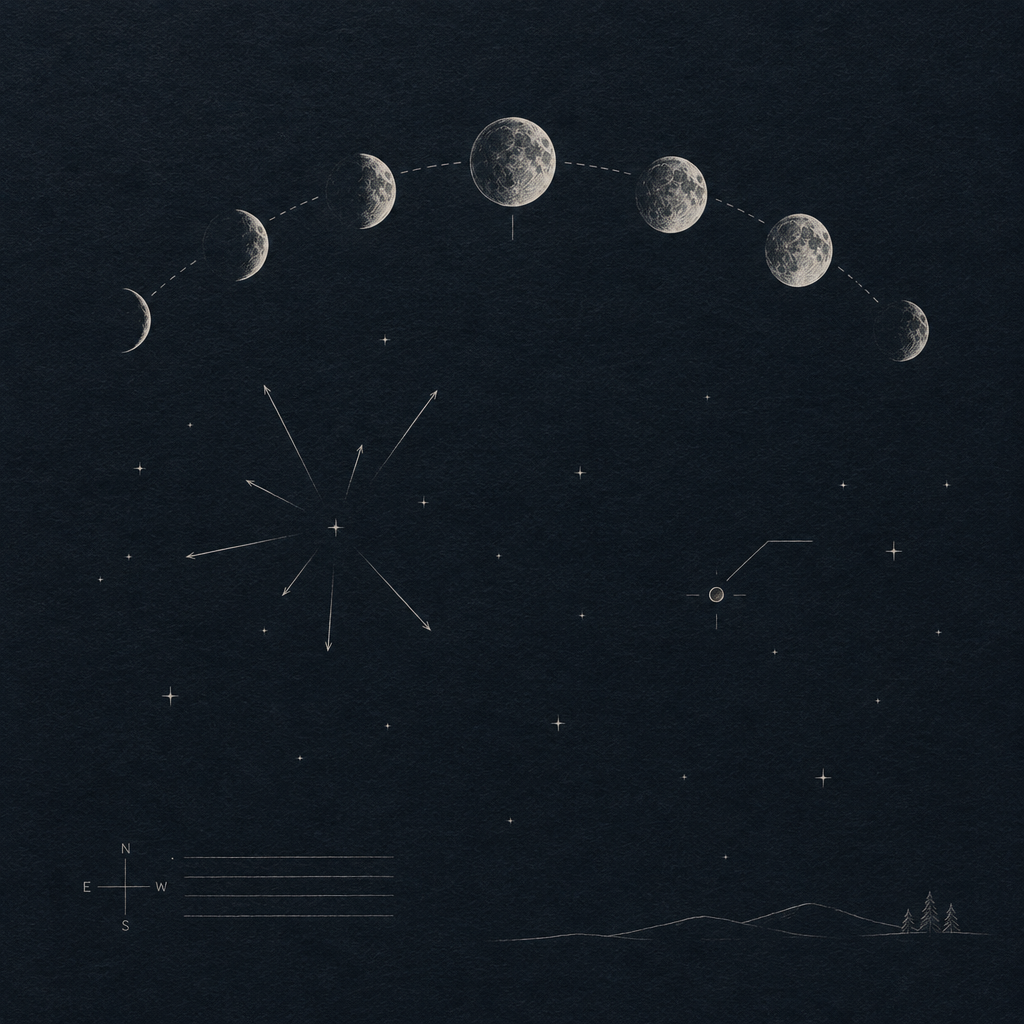
Minimal star chart sketch showing moon phase arc, meteor radiants, and Mars position on a dark field notebook page
Notebook-style sky sketch used during this weeks session planning.

03 Oct  Waxing Gibbous Moon

At 120 magnification, the terminator near Copernicus showed crisp terrace edges, with brief moments of steady seeing revealing fine shadow texture along the crater walls.

05 Oct  Early Meteors

From 22:10 to 23:00, we logged seven faint streaks in the northeast, most lasting under a second but clearly brighter once local porch lights dimmed.

07 Oct  Mars in the East

Mars rose through light haze just after 21:30; by 22:00 it held a steadier orange tone, and several beginners were able to reacquire it quickly with finder scopes.

Next up: seasonal highlights and timing windows.

See upcoming sky events

Upcoming sky events

What to watch in the night sky next

A quick field note of timely celestial highlights to guide your next clear-sky session.

Featured watch

Orion rising earlier each evening

Timing cue: this month after dusk

A reliable seasonal marker for beginners: easy belt-star recognition makes it a strong reference for orienting to nearby winter constellations.

Jupiter near the eastern horizon

On clear evenings

Bright and steady, it helps observers compare planetary light with nearby stars and practice early-session sky alignment.

Waxing Moon crossing first quarter

This week at twilight

Terminator shadows sharpen crater edges, making this phase especially useful for shared lunar sketching and beginner telescope practice.

Pleiades high in the night arc

Best after local evening dark

A compact cluster that rewards unaided-eye viewing and binocular comparison, ideal for group discussions on stellar color differences.

Community nights

Upcoming meetups under the night sky

Friendly sessions for beginners and regular observers, with clear guidance and space to ask questions.

What a typical gathering feels like

We usually begin with a short sky orientation, then move through visible targets together using printed star maps and shared telescopes. Volunteers help with setup, eye adjustment, and simple observing techniques, so first-time attendees can settle in comfortably.

New to club nights? You are welcome to observe quietly, borrow equipment, and join at your own pace.

Friday · 19:30

Moonwatching Evening

A relaxed lunar session focused on crater detail, phases, and practical viewing tips for binocular users.

Saturday · 20:00

Constellation Walk

An outdoor orientation where we trace seasonal constellations and practice finding bright guide stars by eye.

Sunday · 19:00

Telescope Sharing Night

Bring your scope or try a club instrument while members compare setups and offer beginner-friendly guidance.

Common Questions

Before your first night out

Quick answers to the questions we hear most from new visitors.

Are beginners welcome at club meetups?
Yes. Newcomers are always welcome, and volunteers explain what we are viewing in clear, beginner-friendly terms.
What should I bring for a meetup?
Bring warm layers, a red-light flashlight if you have one, and any binoculars or telescope you want help using.
How do meetups usually work?
We start with a short sky overview, then observe in small groups while members share targets, tips, and conditions.
Do I need to be a member to attend?
No membership is required for most public sessions. If a special event has limits, we note it in the announcement.
What kinds of observations does the club share?
We post practical notes on planets, the Moon, bright deep-sky objects, and seasonal highlights visible to amateurs.

Ready to join a session? See upcoming meetups.